Helen Maroulis was bleeding in Kazakhstan.
A cut above her right eye had interrupted her bronze-medal match at the 2026 Senior World Wrestling Championships in Astana. Her head was wrapped so she could continue. Across from her stood Kazakhstan’s Nilufar Raimova, an Asian Games bronze medalist with a home crowd behind her.
Maroulis had led 4–0 at the break. Raimova pressed in the second period, but the American held on for a 5–2 victory.
Her ninth Senior World Championships medal.
Another place in the history books for the first American woman ever to win Olympic wrestling gold.
And, remarkably, another medal in a career that began when American girls had far fewer opportunities to wrestle than they do today.
A day later, more than 1,100 girls were on the registration list for the Brian Keck Memorial Preseason Nationals in West Des Moines, Iowa.
Some are high school wrestlers with state championships, national rankings and college ambitions.
Others are in elementary school.
Thirty-three are registered in the first- and second-grade division.
They are entering a sport that women like Maroulis spent their careers transforming.
And many of them may never fully appreciate how different that world once was.
That’s the measure of what those women accomplished.
Before There Was a Revolution
Women’s wrestling did not begin with Olympic gold medals or sold-out arenas.
For generations, girls who wanted to wrestle often had to compete against boys, train in rooms where they were the only female athlete, or travel considerable distances to find appropriate competition.
There were talented women, dedicated coaches and international opportunities long before the sport gained widespread recognition in American schools.
But the competitive infrastructure was limited.
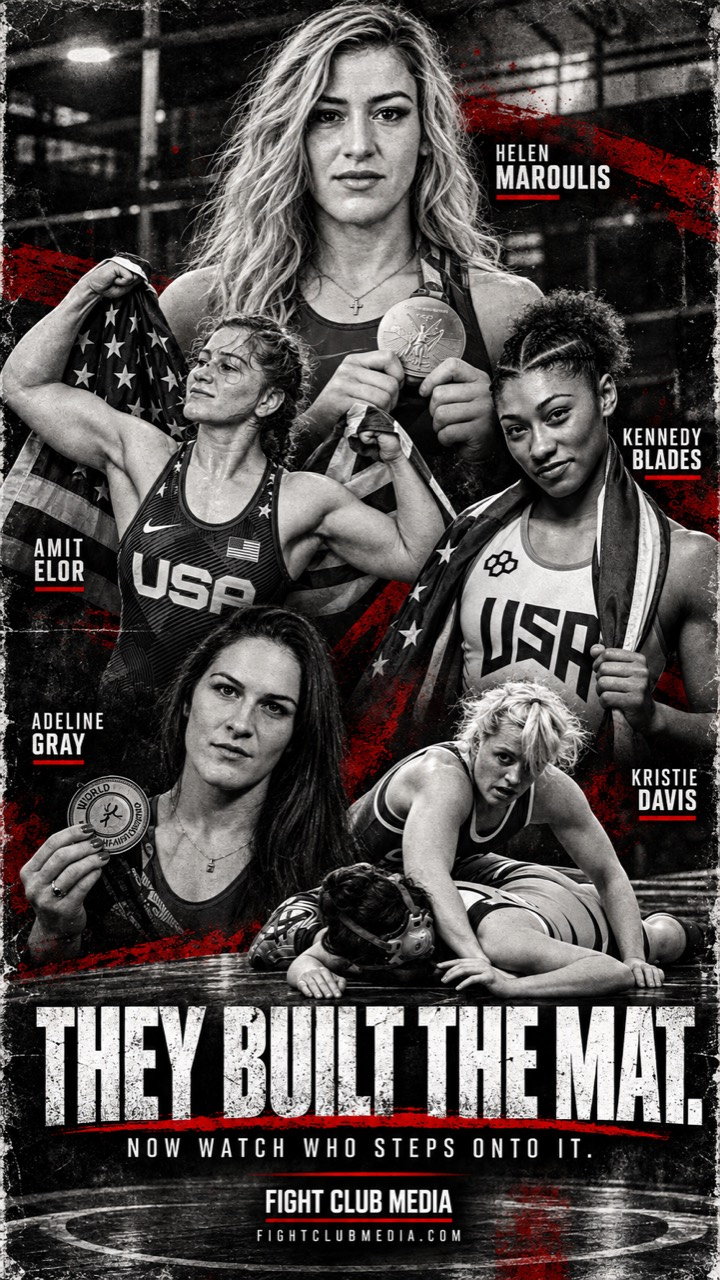
Kristie Davis was one of the athletes who demonstrated what American women could accomplish without the opportunities their successors would eventually inherit.
Davis won seven World medals before women’s wrestling made its Olympic debut in 2004, and finished her career with nine. [1]
Women’s freestyle finally joined the Olympic program at Athens in 2004.
That was an important milestone, but Olympic recognition didn’t instantly create girls’ wrestling teams in American high schools. It didn’t guarantee college scholarships or produce a nationwide youth development system.
Those changes required years of work.
Adeline Gray became another defining figure in that transformation.
A six-time world champion and Olympic silver medalist, Gray helped establish the United States as a country capable of producing dominant female wrestlers year after year.
She represented a new standard of excellence.
Then Helen Maroulis changed the conversation.
The Gold Medal That Changed Everything
At the 2016 Olympic Games in Rio de Janeiro, Maroulis faced Japan’s Saori Yoshida in the 53-kilogram final.
Yoshida was one of the greatest wrestlers in history, a three-time Olympic champion whose international dominance had made her nearly synonymous with the sport.
Maroulis defeated her 4–1.
It was the first Olympic wrestling gold medal ever won by an American woman.
The significance extended beyond the result.
Young girls across the United States suddenly had an American Olympic champion who looked like them, competed in their sport and had defeated one of the most accomplished athletes wrestling had ever produced.
The possibility of becoming an Olympic champion was no longer hypothetical.
It had a name.
Ten years later, Maroulis is still competing against the world’s best.
Her bronze medal in Astana brought her to nine Senior World medals, tying the American record shared by Bruce Baumgartner, Jordan Burroughs, Kristie Davis and Adeline Gray.
No American wrestler has reached ten.
And while Maroulis continues to pursue history, the generation she helped inspire is already writing its own.
Amit Elor and the Generation That Followed
Amit Elor was 12 years old when Maroulis won gold in Rio.
Eight years later, Elor became an Olympic champion herself.
At the 2024 Paris Games, the 20-year-old American captured gold at 68 kilograms, becoming the youngest American wrestler, male or female, to win Olympic gold.
Her rise represented something different from the generation that preceded her.
Elor grew up in a country where American women had already won world championships and Olympic medals. She could look toward established national teams, high-level coaching and an expanding competitive pathway.
The sport had begun to provide opportunities that earlier champions had spent years helping create.
Kennedy Blades offered another glimpse of that progression in Paris.
At 20, Blades earned Olympic silver at 76 kilograms, demonstrating that America’s next generation was not waiting until its late twenties to contend for international medals.
For Kennedy Blades, the connection to Preseason Nationals is direct. Long before she won Olympic silver, she placed third at the tournament in 2011 and finished runner-up in 2014 and 2015. The girls competing this weekend are stepping into a tournament that was part of her own development. [2] [3]
And the development continues.
Dymond Guilford earned her first Senior World medal in Astana on the same day Maroulis collected her ninth. Guilford defeated Türkiye’s Kadriye Kocak Aksoy 7–2 for bronze at 76 kilograms.
One American woman was extending a historic career.
Another was establishing herself on the world podium.
That is what a successful development system is supposed to produce.
Not one exceptional athlete every decade.
A succession of them.
The Numbers in Iowa Tell Their Own Story
The registration list for the 2026 Brian Keck Memorial Preseason Nationals contains 1,150 girls across four grade divisions.
There are 686 high school wrestlers, 284 in grades six through eight, 147 in grades three through five, and 33 in first and second grade.
These aren’t national participation statistics. They represent one tournament’s registration snapshot, and they don’t establish how many girls will ultimately compete after weigh-ins.
But they offer a remarkable picture of the sport’s development.
A tournament that includes hundreds of high school girls and hundreds more in elementary and middle school isn’t simply serving the current generation.
It is helping develop the next one.
The younger divisions are particularly significant.
Girls who begin competing in elementary school have opportunities to accumulate years of wrestling experience before entering high school. They can learn how to handle difficult losses, develop technique, understand tournament pressure and build confidence against other female competitors.
By the time they reach varsity competition, wrestling may already be a familiar part of their lives.
That was not the experience available to many of the sport’s pioneers.
And it changes what coaches can reasonably expect from a young athlete.
The modern high school freshman may arrive with national tournament experience, hundreds of matches and a technical foundation developed over years of organized competition.
The result is a higher standard across the field.
Not just at the top.
Everywhere.
From Youth Clubs to National Competition
The Keck registration list reflects a broad collection of wrestling programs.
Sebolt Women’s Wrestling, Askren Wrestling Academy, Team Nazar Training Center, Greater Heights Wrestling, Nebraska Wrestling Academy, Jackrabbit Wrestling Academy and numerous other programs have athletes represented across the girls’ divisions. [4]
Some clubs appear in multiple age groups.
That matters.
A development program that brings elementary-school girls into wrestling and continues training them through high school can provide more than individual tournament preparation.
It creates continuity.
Younger athletes can watch older teammates compete. Experienced wrestlers can become mentors. Coaches can build technique progressively rather than introducing the sport to athletes for the first time in ninth grade.
And girls can enter a wrestling room knowing they won’t necessarily be the only female athlete there.
The value of that environment is difficult to overstate.
A young wrestler’s first experience with the sport can determine whether she continues for another season or leaves before discovering what she might become.
The growth of dedicated girls’ competition gives more athletes a reason to stay.
The High School Generation Is Already Accomplished
The 686 high school girls registered at Keck include athletes with significant national experience.
Winter West arrives as a 2026 Fargo 16U freestyle champion at 125 pounds.
Brielynn Jackson won a 16U folkstyle national championship at 115 earlier this year.
Melanie Medrano reached the 125-pound national folkstyle final.
Daelin Cody enters with national ranking credentials at 130.
Lilly Lundy has represented the United States at the U17 World Championships.
Those accomplishments reflect the standard that today’s leading high school girls are expected to meet.
Winning a state championship remains a significant achievement.
But for many of the country’s most ambitious young wrestlers, state competition is only one part of the calendar.
Freestyle, folkstyle, national duals, international age-group events and major open tournaments now provide additional ways to test themselves.
The result is a generation of athletes who are increasingly comfortable competing beyond their home states.
They don’t arrive at a national tournament simply hoping to discover whether they belong.
Many already know the level of competition.
They’ve been wrestling against it for years.
Texas Is Part of the Change
Texas offers a particularly interesting perspective on the expansion of girls’ wrestling.
The state has an established UIL girls’ wrestling championship structure, and its athletes are increasingly visible in national competition.
Among the Texas-connected names on the Keck registration list are Lucy Clarno of 3F, Kylie Keach of Apex Grappling Academy, Mila Juarez of 3F Wrestling, Kaeli Forrester of Silverback Wrestling Fort Worth and C. Kalena Vanlandingham of Socorro High School.
The list also includes girls from Texas-associated programs such as 817 Wrestling Club, Carrollton Thunder and Gracie Barra Westchase Wrestling.
Their presence illustrates how the sport extends beyond the traditional high school season.
Clarno is a former UIL state champion. Keach won the UIL District 5-6A title as a freshman, along with the 2026 USA Wrestling Texas ninth-grade folkstyle championship and the 2025 Texas 14U freestyle state championship.
Their accomplishments came through different competitive paths, but both now have the opportunity to compete against a national field.
That progress extends beyond the Keck entry list. Houston’s Vivienne ‘Vivi’ Yarbrough, of Gracie Barra Westchase, went 4–2 at 120 pounds in the 16U girls’ division at Fargo this summer. Hailey Delgado finished second at 120 pounds in Junior girls’ freestyle, while Audrey Cunningham was the 16U girls’ runner-up at 110. Their performances show the depth developing across Texas, from youth clubs to the national stage. [5] [6]
And the younger Texas wrestlers on the registration list represent something equally important.
The state’s development pipeline isn’t limited to the athletes already competing for high school championships.
It includes girls who are years away from varsity wrestling.
Some of them may become the next generation of Texas state champions.
Others may eventually represent the country internationally.
The important development is that they have opportunities to begin that journey now.
College Wrestling Changes the Stakes
For decades, one of the greatest challenges facing American female wrestlers was the limited number of opportunities to continue competing after high school.
That landscape has changed dramatically.
Women’s wrestling has expanded across collegiate programs, and the inaugural NCAA women’s wrestling championship in March 2026 marked another major step toward institutional recognition. [7]
For high school athletes, the implications are substantial.
Wrestling can now be more than an extracurricular activity or a path toward international competition.
It can also provide opportunities to pursue a college education while continuing to compete.
The development of collegiate wrestling creates another reason for families, schools and clubs to invest in girls’ programs.
And it gives young athletes a longer competitive horizon.
A sixth-grader entering a wrestling tournament today may have years of youth competition, high school wrestling and college wrestling ahead of her.
That kind of pathway changes a sport.
It changes how athletes train, how coaches recruit and how seriously institutions invest in development.
Most importantly, it gives girls more choices.
But the work is far from finished. USA Wrestling counted just 10 current or announced women’s wrestling programs at Division I schools this October, including three that will not begin varsity competition until 2027–28. Ten is simply not enough. Oklahoma State should build on its successful women’s club by making the varsity commitment, and Penn State’s University Park campus should join the movement. These girls deserve more college opportunities, and more of wrestling’s biggest institutions need to create them. [7] [8]
The Next Generation Won’t Know Any Different
The wrestlers competing in West Des Moines this weekend represent different stages of the same journey.
The youngest are learning the sport.
The middle-school competitors are developing their skills and beginning to establish competitive identities.
The high school athletes are chasing national titles, college opportunities and, in some cases, international ambitions.
They are separated by age, experience and ability.
But they share something that earlier generations worked to make possible.
They have a place to compete.
That doesn’t mean every obstacle has disappeared. Girls’ wrestling still faces disparities in resources, coaching opportunities, participation and institutional support.
Growth doesn’t eliminate the work that remains.
But it changes what is possible.
Kristie Davis helped demonstrate that American women could compete with the world’s best before the sport had an Olympic stage.
Adeline Gray established a standard of sustained international excellence.
Helen Maroulis broke through the barrier that separated American women from Olympic wrestling gold.
Amit Elor and Kennedy Blades showed how quickly the next generation could rise.
And now, in Iowa, 1,150 registered girls are preparing to compete in a tournament that offers divisions from first grade through high school.
Some will win championships.
Most won’t.
Some may eventually wrestle in college. A handful might reach the world stage.
But every one of them has an opportunity that previous generations helped create.
Helen Maroulis fought through a cut above her eye in Kazakhstan to win her ninth world medal.
Thousands of miles away, young girls were preparing for a wrestling tournament in Iowa.
Many of them weren’t born when Maroulis won her first world title.
Some weren’t born when she won Olympic gold.
They may never have to fight the same battles simply to find a place in the sport.
And that is perhaps the greatest accomplishment of all.
Somewhere in Iowa this weekend, a young girl will step onto the mat without giving a second thought to whether she belongs there.
That’s what the women before her accomplished.
Sources
- USA Wrestling: History lesson — Kristie Davis
- USA Wrestling: Kennedy Blades athlete biography
- USA Wrestling: 2015 Preseason Nationals results
- Greater Heights Wrestling: Program locations
- Wrestling Texas: Texas women end Fargo run with 10 All-Americans
- Gracie Barra Westchase: Wrestling programs
- USA Wrestling: Women’s College Notebook — Setting the stage for the 2026–27 season
- Penn State: University Park prospective athlete forms