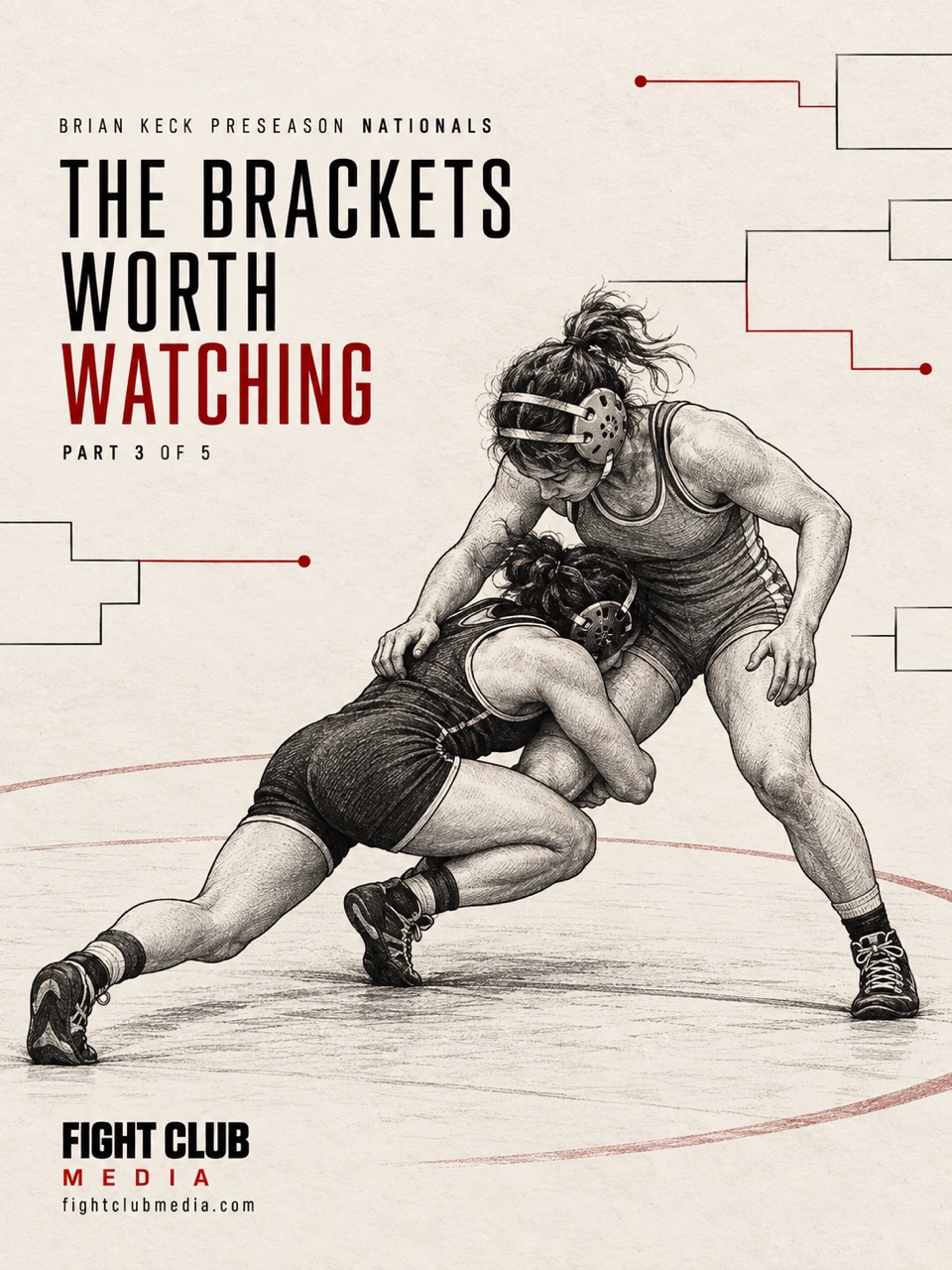
Winter West didn’t leave much room for argument at Fargo.
In the 16U girls’ 125-pound championship, she defeated Presley Beard by technical fall, 11–0. In the semifinals, she pinned Hailey Worden in 2:28. Her final two opponents never reached a decision.
Three months later, West returns to national competition at Brian Keck Memorial Preseason Nationals, where her 125-pound bracket includes a folkstyle national champion, a national runner-up, a Texas state champion and dozens of wrestlers with something to prove.
Brielynn Jackson, Melanie Medrano and Lucy Clarno are among the 64 registered competitors.
So are Carmen Davidson, Giana Grabot, Ruby Roof, Alaina Roffers, Julia Schnell and Kylie Keach.
And that’s just one division.
Across the girls’ 110–155-pound classes and the upperclassmen boys’ 138–215-pound divisions, 1,105 registration entries offer a collection of athletes, competitive histories and potential matchups worth examining.
Some arrive with national championships. Others bring state titles, regional championships or years of national tournament experience.
All of them start at zero.
Girls’ 125: A National Championship Doesn’t Guarantee Another
West enters the tournament as the reigning Fargo 16U champion at 125 and was ranked ninth nationally in the October preseason rankings.
Those credentials establish her as one of the division’s most accomplished competitors. But folkstyle introduces challenges that freestyle results alone cannot answer.
Jackson has already demonstrated what she can do under those rules.
In March, she won the 16U Folkstyle Nationals championship at 115 pounds, defeating Roselane D. Verrett 13–0 in the final. Earlier that month, Jackson captured the Kansas Class 6A state championship at 110.
Her move to 125 creates an interesting question: can the offense that carried her to championships at lighter weights produce the same results against larger opponents?
Medrano offers a different challenge.
Her run to the 125-pound national folkstyle final required consecutive close victories. She defeated Karris Carter 6–4 in the quarterfinals and Aspen Walker 6–5 in the semifinals before losing to Corabella Wesley 7–3.
She has already demonstrated an ability to survive difficult matches against national competition under folkstyle rules.
A potential West–Jackson meeting would bring together champions from two different styles. Medrano has the experience to complicate either wrestler’s route to the final.
But with 64 registered competitors, the bracket extends well beyond those three names.
Texas Has Something to Prove at 125
Lucy Clarno won a UIL state championship for Dripping Springs in 2025. She returned to the podium in 2026, finishing fourth after winning the Region IV-6A championship.
Her sophomore season ended with a 32–2 record.
Kylie Keach, a sophomore at Rockwall-Heath, brings a different résumé.
Keach won the UIL District 5-6A championship as a freshman at 125 pounds. She also captured the 2026 USA Wrestling Texas 9th Grade Folkstyle State Championship and the 2025 Texas 14U Freestyle State Championship.
A three-time member of Team Texas at Women’s National Duals, Keach brings experience against national competition in addition to her accomplishments in both UIL and USA Wrestling.
Her high school postseason ended prematurely when illness forced her withdrawal from regionals, leaving her without the state tournament result that ordinarily helps establish a wrestler’s standing.
Clarno and Keach have already faced one another, with Clarno emerging victorious from a competitive match. Keach found opportunities on her feet and threatened near-fall points, but Clarno ultimately secured the win.
Their previous meeting adds another layer of intrigue to the 125-pound bracket. Clarno has already proven she can beat Keach, while Keach has demonstrated that she can create scoring opportunities against the former state champion.
Both arrive in Iowa with championship credentials and something to prove against a national field. A potential rematch would offer another measure of how far each has progressed.
And the rest of the field offers plenty of obstacles.
Davidson, Grabot, Roof, Roffers, Schnell and Bella Arellano-Gandy are among the other registered competitors. Several have appeared in significant national events and against opponents familiar to the wrestling community.
The challenge at 125 isn’t simply defeating one nationally ranked wrestler.
It’s advancing through a bracket that may require six consecutive championship-side victories, against opponents with different strengths, styles and competitive experience.
The draw will matter.
So will the ability to adjust when a match doesn’t unfold as expected.
Girls’ 130: Another Division Worth Watching
The 125-pound field may feature the more recognizable championship storyline, but girls’ 130 offers another intriguing collection of competitors.
Daelin Cody enters the tournament ranked No. 11 nationally at 130 pounds.
Madelyn Medrano, previously ranked among the nation’s top wrestlers at 125, is also registered at 130.
Alexis Lauta joins them in a 52-wrestler field.
Cody’s national standing makes her a natural athlete to follow. Medrano’s move into the division creates another question about how established competitors perform when changing weight classes.
But rankings are only part of the equation.
Different opponents present different problems. A wrestler who thrives in neutral exchanges may struggle against someone with exceptional top control. Another may be particularly dangerous in close matches, where one reversal or near-fall sequence can decide the outcome.
At 130, those differences could become especially important.
Girls’ 115: A National Finalist Returns
Roselane D. Verrett is registered at 115 pounds after reaching the 2026 16U Folkstyle Nationals championship match.
She lost that final to Brielynn Jackson, 13–0.
Now Jackson is competing at 125, while Verrett remains at 115.
Their separation illustrates how quickly the competitive landscape changes between seasons.
Athletes who met for a national championship in March may find themselves pursuing entirely different titles in October.
For Verrett, Preseason Nationals offers another opportunity to turn national-final experience into a championship.
Girls’ 140: A Returning Champion Takes the Next Step
Katie Davidson won the sixth–eighth-grade girls’ 140-pound championship at the 2025 Preseason Nationals.
This year, she’s registered at 140 in the high school girls’ division.
The weight is familiar. The competition is not.
Moving from middle-school competition into a high school bracket means facing older wrestlers with additional years of development and experience.
Davidson has already won at this tournament.
Her next challenge is demonstrating that the success carries into a more demanding division.
Boys’ 144: Quincey Crawford Returns for Another Title
Quincey Crawford won the ninth–tenth-grade 144-pound championship at Preseason Nationals in 2025.
This year, he’s registered in the eleventh–twelfth-grade division at the same weight.
The distinction matters.
A national title against underclassmen is an accomplishment. Returning to face older, more physically developed competition presents a different challenge.
Crawford knows what it takes to win at Keck.
But the 2026 upperclassmen bracket contains 101 registered wrestlers, making it one of the tournament’s largest divisions in the selected coverage range.
His previous championship establishes expectations.
It doesn’t make the path to another title any easier.
Boys’ 150: The Biggest Field in the Spotlight
With 105 registered wrestlers, the eleventh–twelfth-grade 150-pound division is the largest boys’ bracket in our selected coverage range.
Texas-affiliated clubs have several competitors entered, including Samuel Dial of PSF Wrestling Academy, Dominic Contreras of 817 Wrestling Club, Sawyer Jorgensen of Greater Heights Wrestling and Charles Lundin of 3F Wrestling.
Their presence adds another Texas connection to a division with significant national participation.
But field size alone doesn’t determine quality.
A large bracket can require a demanding series of matches, yet the real measure of competitive strength comes from the athletes themselves: their previous results, the opponents they’ve defeated and their ability to adapt against different styles.
At 150, there will be no shortage of opportunities for an emerging wrestler to make an impression.
The Upperweights: Fewer Entries, No Shortage of Challenges
The numbers begin to narrow as the boys’ divisions get heavier.
There are 97 registered wrestlers at 157, 66 at 165, another 66 at 175, 48 at 190 and 22 at 215.
The smaller fields don’t necessarily mean easier championships.
At 190, Owen Andrews of Temple High School is among the registered competitors, providing another Texas connection to the upperweight competition.
These divisions can produce matches decided by the smallest technical advantages.
Position, balance, hand fighting and the ability to capitalize on a single scoring opportunity often become decisive when two accomplished wrestlers are evenly matched.
The strongest upperweights combine physicality with technical precision.
And when both athletes possess those qualities, one exchange can change everything.
What the Rankings Cannot Tell Us
Preseason Nationals arrives at an interesting moment on the wrestling calendar.
Fargo closes the summer’s national competition. Keck opens the next cycle.
The athletes bring their previous accomplishments with them, but the results don’t always translate neatly.
A freestyle national championship isn’t the same as a folkstyle title. A state championship in one region doesn’t necessarily represent the same competitive path as a championship elsewhere.
And rankings, while useful, can struggle to account for wrestlers who have missed major events, changed weight classes or improved significantly since their last national appearance.
That is what makes the actual competition so compelling.
West’s Fargo championship matters. Jackson’s folkstyle title matters. Clarno’s state championship matters. Crawford’s previous Keck title matters.
But none of those accomplishments awards a point when the whistle blows.
The Boys National High School Recruiting Showcase begins Friday, October 30, at 3 p.m. Central. High school girls’ competition begins Saturday, October 31, at 9 a.m.
Across the weekend, returning champions will try to repeat, national contenders will test themselves against unfamiliar opposition, and emerging wrestlers will have opportunities to establish their names.
Some of the most revealing matches may happen long before the finals.
And somewhere among the thousands of wrestlers competing in West Des Moines, another future national star may be preparing for the performance that changes the course of a career.
We may not recognize its significance until years later.
But the results will be there.
And the names will have been there all along.